

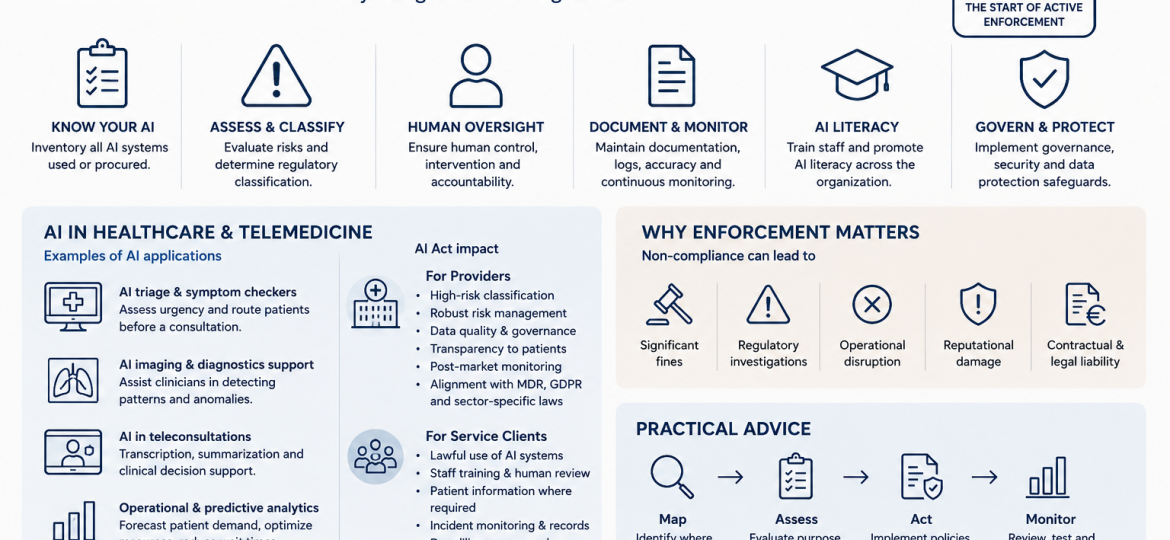
The European Union AI Act has changed the way organizations use artificial intelligence. The milestone of 2 August 2026 marked the transition from regulatory preparation to active enforcement for many of the Regulation’s core obligations. Since then, AI governance has become an essential element of corporate compliance rather than a future planning exercise.
Today, every organization that develops, procures or uses AI systems should understand that AI compliance is no longer limited to technology teams. It affects legal departments, compliance officers, risk managers, procurement, cybersecurity, human resources and senior management.
AI compliance is not only for AI developers
One of the most common misconceptions is that the AI Act only applies to companies that build artificial intelligence.
It does not.
The Regulation also creates important obligations for organizations that deploy AI systems in their daily operations. Businesses remain responsible for the lawful and responsible use of AI, even when the technology comes from established software vendors or cloud providers.
Organizations should know which AI systems they use, understand their intended purpose, assess their regulatory classification and establish appropriate governance measures.
AI governance becomes part of corporate governance
The AI Act introduces a structured framework for managing AI-related risks.
Organizations should implement:
- AI system inventories
- AI risk assessments
- Human oversight procedures
- AI governance policies
- Internal accountability mechanisms
- Vendor due diligence
- Documentation and monitoring processes
- AI literacy programmes for employees
These measures support regulatory compliance while improving operational resilience and decision-making.
AI governance should integrate with existing GDPR, cybersecurity, information security and enterprise risk management programmes rather than operate as a separate compliance function.
Healthcare organizations face higher regulatory expectations
Healthcare represents one of the sectors most affected by the AI Act.
Hospitals, private clinics, diagnostic centres, medical device manufacturers, telemedicine providers and digital health companies increasingly rely on artificial intelligence for clinical support, imaging, patient triage, scheduling, predictive analytics and operational efficiency.
Many of these applications may qualify as high-risk AI systems, depending on their intended purpose and regulatory classification.
Healthcare organizations should therefore pay particular attention to:
- clinical oversight and human decision-making;
- transparency towards patients and healthcare professionals;
- quality of training and input data;
- documentation and traceability;
- cybersecurity and system robustness;
- post-deployment monitoring;
- integration with medical device regulation, GDPR and sector-specific healthcare legislation.
Healthcare AI requires more than technical accuracy. It requires demonstrable governance.
Enforcement changes business risk
The AI Act introduces one of the most comprehensive regulatory frameworks for artificial intelligence worldwide.
Regulatory authorities may impose significant administrative fines, but financial penalties represent only part of the risk.
Organizations should also consider:
- regulatory investigations;
- operational disruption;
- contractual liability;
- procurement restrictions;
- reputational damage;
- investor and board scrutiny;
- increased litigation exposure.
For many businesses, AI governance now forms part of their overall ESG, compliance and enterprise risk strategy.
Practical steps for companies using AI
Organizations should start with a simple question: where do we actually use AI?
In practice, this means preparing an AI inventory. The inventory should cover AI tools used in recruitment, customer support, clinical workflows, marketing, fraud detection, document review, cybersecurity, scheduling and analytics. It should also include AI functions embedded in existing software platforms, even when the organization does not describe them internally as “AI”.
The next step is classification. Companies should assess whether each AI system falls within a prohibited practice, a high-risk category, a transparency obligation or a lower-risk use case. This classification should not rely only on the vendor’s description. The actual intended use by the organization matters.
For example, an AI chatbot used only to answer general customer questions may trigger transparency obligations. An AI tool used to screen job candidates may fall within the high-risk framework. A system that supports credit scoring, insurance underwriting or patient triage may require a much deeper compliance review.
Companies should also review their vendor contracts. Procurement teams should ask whether the provider supplies technical documentation, instructions for use, audit information, data governance evidence, cybersecurity safeguards and support for regulatory compliance.
Telemedicine, healthcare AI and the AI Act
Telemedicine providers should pay particular attention to the AI Act because many digital health tools combine remote healthcare services with automated decision support.
For example, a telemedicine platform may use AI to triage patients before a consultation, suggest urgency levels, assist doctors with symptom analysis, support diagnostic pathways, summarize medical histories or prioritize appointments. Depending on the intended purpose, some of these tools may qualify as high-risk AI systems, especially where they influence clinical decisions or patient access to healthcare.
For providers of telemedicine platforms, the AI Act may require robust risk management, technical documentation, data governance, human oversight, accuracy and cybersecurity controls, post-market monitoring and clear instructions for professional users. Where the AI function forms part of a medical device or supports diagnosis or treatment, the assessment must also align with medical device regulation and healthcare-specific rules.
For service clients, such as clinics, hospitals, diagnostic centres or insurers using a telemedicine platform, the key issue is not only whether the vendor is compliant. They must also use the system lawfully. They should train personnel, define when doctors may rely on AI outputs, ensure human review, inform patients where required, monitor incidents and keep evidence that the system operates within its approved purpose.
A practical example is an AI-powered symptom checker used before a remote consultation. If it only helps route patients to the right medical specialty, the risk profile may differ from a system that suggests a probable diagnosis or recommends urgent treatment. Another example is AI transcription and summarization of video consultations. This may create transparency, confidentiality, GDPR, medical secrecy and data retention issues, even when it does not qualify as high-risk AI.
Healthcare organizations should therefore treat AI compliance as part of clinical governance, not as a separate legal checklist.
How KKLegal supports organizations
KKLegal combines legal, regulatory and technology-sector expertise in AI, digital health, GDPR, cybersecurity and healthcare regulation. Our team has worked on complex technology deployments, healthcare platforms, telemedicine models, data-driven services and regulated digital transformation projects in Greece and abroad.
We help organizations translate the AI Act into practical governance: AI mapping, risk classification, contractual safeguards, compliance roadmaps, internal policies, board-level advice and sector-specific implementation. Our approach is legal, technical and operational, because AI compliance only works when it reflects how the business actually uses the technology.